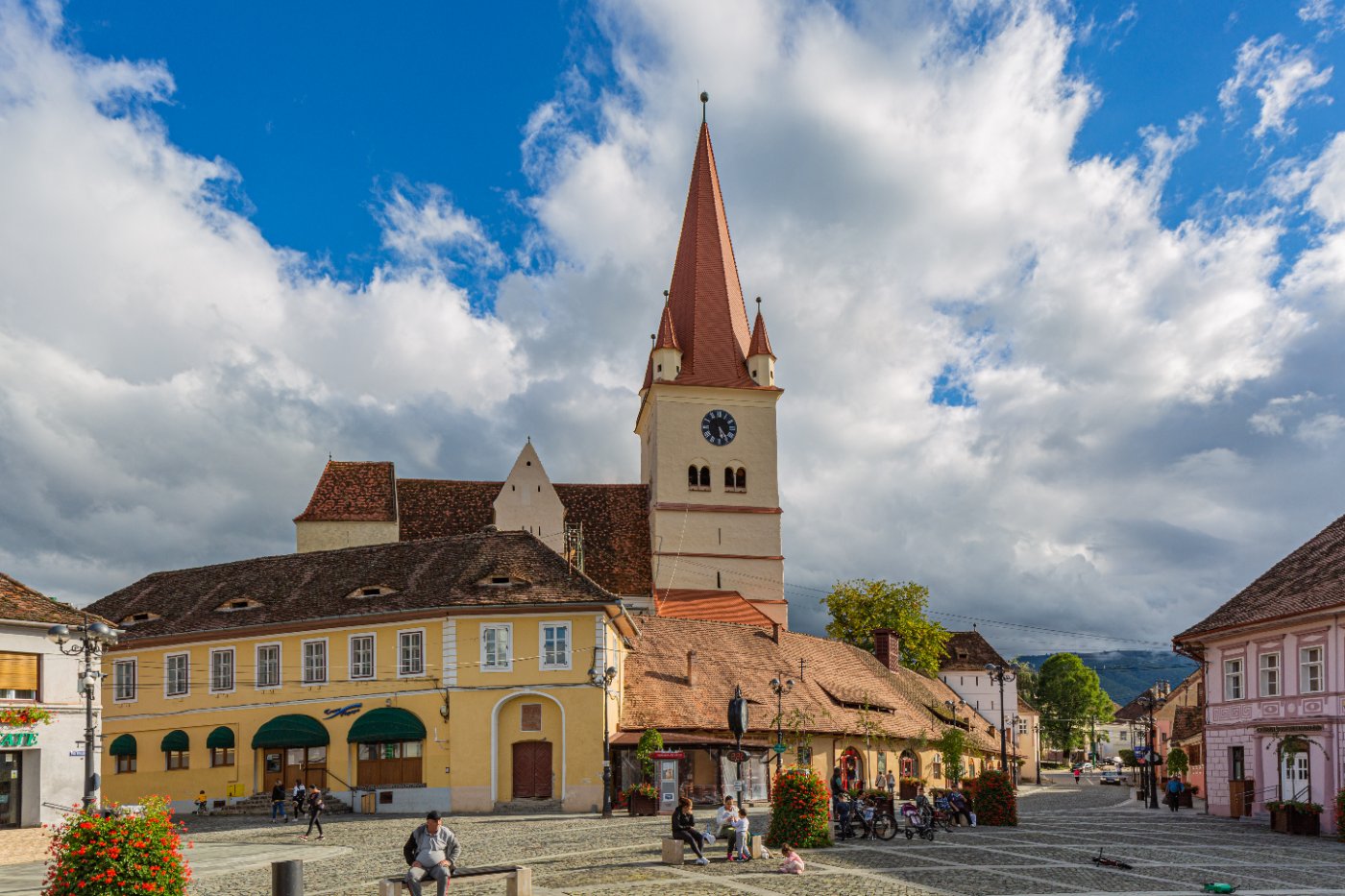
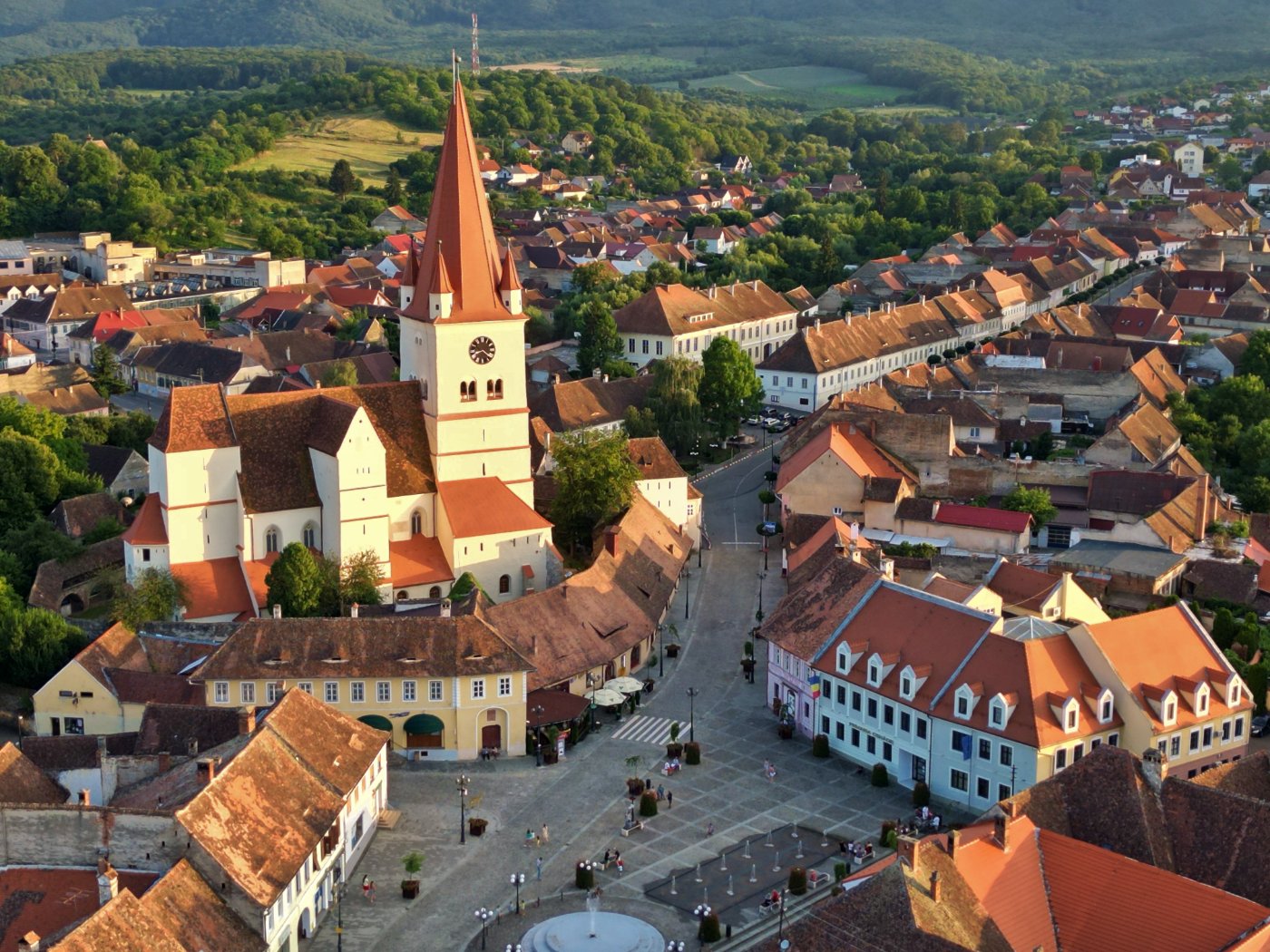
A living evangelical congregation at the foot of the Cindrel Mountains, one of the most beautiful fortified churches in Transylvania. Our doors are open to everyone.
Service
Sundays, 10:00 am
St. Walburga Church
Fortified Church
Daily, 11 am – 4 pm
Tours by arrangement
Parish Office
Tue – Thu, 9 am – 2 pm
Pastor László-Zorán Kézdi
Welcome to Heltau
We are an evangelical Lutheran congregation in the heart of Heltau, where around 250 people share a close-knit community.
At the centre of our congregational life stands our encounter with the mystery of God, in proclamation, community and daily life. The space for this is the medieval fortified church, named after St. Walburga. It is both a historic monument and a living place of worship, accomplished church music and personal encounter. Our doors are open to everyone, regardless of background, upbringing or way of life.
Our Theological Profile
Being Evangelical in Heltau
Unconditional Openness
We understand the Gospel as the message of being unreservedly accepted by God, by grace, not on the basis of our merit, but through faith alone. Those who doubt are welcome. Those who question, too.
The Principle of Turning Toward Others
Word and Sacrament are the centre of our spiritual life, sustaining and calling us at once. For true spirituality shows itself in sincere care for one's neighbour and active engagement for the common good.
History Meets Modernity
The centuries-old history of our fortified church and our congregation's Reformation heritage are both an obligation and an inspiration: to shape Christian faith in the 21st century in a contemporary, intellectually honest and socially relevant way.
Our Congregation
What You'll Find With Us
Since the 12th century
History & Treasures
Eight Centuries Under One Roof
A 12th-century Romanesque church grew into a late-Gothic hall church, surrounded by defensive walls, towers and storerooms, shelter and house of God at once. To this day this fortified church shapes the townscape of Heltau and bears witness to Transylvanian Saxon history and lived faith.
Parish Office
The Congregation's Coordination Center
The parish office coordinates all activities of the congregation, spiritual as well as administrative. Together, staff and volunteers ensure services, events and pastoral care.
Opening Hours · Tue – Thu, 9:00 am – 2:00 pm
Also reachable outside these hours by arrangement.
László-Zorán Kézdi
Pastor
Claudia Bogdan
Parish Secretary
Cosmina Barna
Church Musician
Robert Bell
Sexton
Werner Schuller
Cemetery Administrator
Rosina Ruopp
Congregational Deacon
Adelina Csaszar
Religious Education
News
From Congregational Life
Plan a Visit
Come Visit Us
The fortified church is open daily from 11 am to 4 pm. Tours in German, Romanian and English, by arrangement.
› Church
St. Walburga Fortified Church
The Heltau Fortified Church
Highlights
What Makes the Fortified Church Unique
› › History
Church
History
Eight centuries are written into these walls, from the 13th-century Romanesque basilica to the restorations of our own time.
Chronicle
1204
First documentary mention
Heltau is mentioned as "villa Ruetel", a Saxon settlement at the foot of the Southern Carpathians, 8 km from Hermannstadt (Sibiu). As it is called a civitas (town), it must already have been significant at the time.
13TH CENTURY
The Romanesque basilica
The settlers build a three-nave Romanesque basilica with a six-storey west tower, dedicated to St. Walburga — an 8th-century abbess venerated as a protector against illness and hardship. Analogies to this patronage are found in the Cologne–Aachen–Liège region, offering clues to the settlers' origin. The nave receives a ribbed cross vault, the aisles a simple cross vault. On the fifth storey of the tower, remains of eight Romanesque twin windows survive to this day.
1395–1430
From church to fortress
Ottoman raids increasingly threaten the region. In 1395 King Sigismund remits part of the taxes of devastated Heltau. Repeated attacks force a massive expansion between 1430 and 1530: double ring walls up to 6 metres high, defensive towers, bastions and a moat between the walls.
1493–1500
Devastation and market rights
On 2 February 1493, Ottoman troops burn the town; as a result, construction on the fortified church is accelerated. Yet in 1500, on the occasion of a visit by King Vladislaus II, Heltau is granted market rights, a testament to the community's resilience.
1544
The Reformation
With Benedictus, the first Lutheran pastor of Heltau is recorded; like almost all Transylvanian Saxons, the community adopts the Evangelical confession. In this turbulent time, the church treasure is hidden in a secret chamber within the fortress walls, a secret kept for generations.
1601–1660
War, siege and plague
In 1601 General Basta, in the service of Austria, captures the fortified church; in 1602 the troops of Sigismund Báthory storm in, three inhabitants of Heltau are killed in front of the church door. In 1602–1603 famine and plague claim two pastors and 107 wool weavers. On 1 June 1660 lightning strikes the church tower, where Heltau's residents had stored their valuables; that same year, 411 inhabitants succumb to a plague epidemic.
1705
The Kuruc raid
On 15 May the town is taken by Hungarian Kuruc leader Count Lorenz Pökri and spared only after payment of 1,500 gold guilders.
1797
First lightning rod east of Vienna
After lightning strikes the church tower again, Heltau receives in 1797 the first lightning rod east of Vienna within Europe.
1822–1896
A boom in the 19th century
The interior of the church receives a Neo-Gothic retable in 1879. The town itself experiences a boom: a new school (1822), a road to Hermannstadt (1859), a rail connection (1894) and electric light (1896).
1919–1948
Industry and upheaval
In 1919 Gromen & Herbert, one of the largest Transylvanian textile companies, is founded. World War II brings heavy losses: in 1944 the Soviet army sets up a prisoner camp, in 1945 able-bodied Saxons are deported to the USSR. In 1948 private enterprises are nationalised, and Heltau becomes a town.
1989–1998
Revolution and emigration
After the fall of the Ceaușescu regime in 1989, around 3,000 of Heltau's 3,512 Saxons emigrate to Germany within two years. In 1997/98 the last major textile company closes, the community experiences its lowest economic point, and has been rebuilding ever since.
2004
800th anniversary
In 2004, 800 years since the first mention of Heltau are celebrated, an occasion for renewed momentum in preserving the fortified church.
2006 – TODAY
The Walburga Prize
Since 2006, the community has awarded the Walburga Prize every two years to individuals and organisations who have rendered outstanding service to Heltau, including Dr. Gerhard Schullerus, Dr. Stefan Cosoroabă, the HOG Heltau, Ilse Harff, Ortrun Binder and Ingrid Buertmes, as well as writer Karin Gündisch and Ortrun Rhein.
2007
Hermannstadt, European Capital of Culture
In the Capital of Culture year, young fortress guides are involved for the first time, introducing visitors to the history of the fortified church and community life, the origin of a tradition that remains alive today.
2013 & 2017
Culture years and Heltau Days
Municipally supported "culture years" bring an open-house day, fortress festival, night of the fortress, autumn festival, theatre, exhibitions and the concert series "Echoes of the Fortress" to Heltau. In close cooperation with the HOG Heltau, including the restoration of medieval manuscripts and various renovation works, the "Heltau Days" take shape in 2013 and 2017.
2014 & 2016
Distinguished visits to Heltau
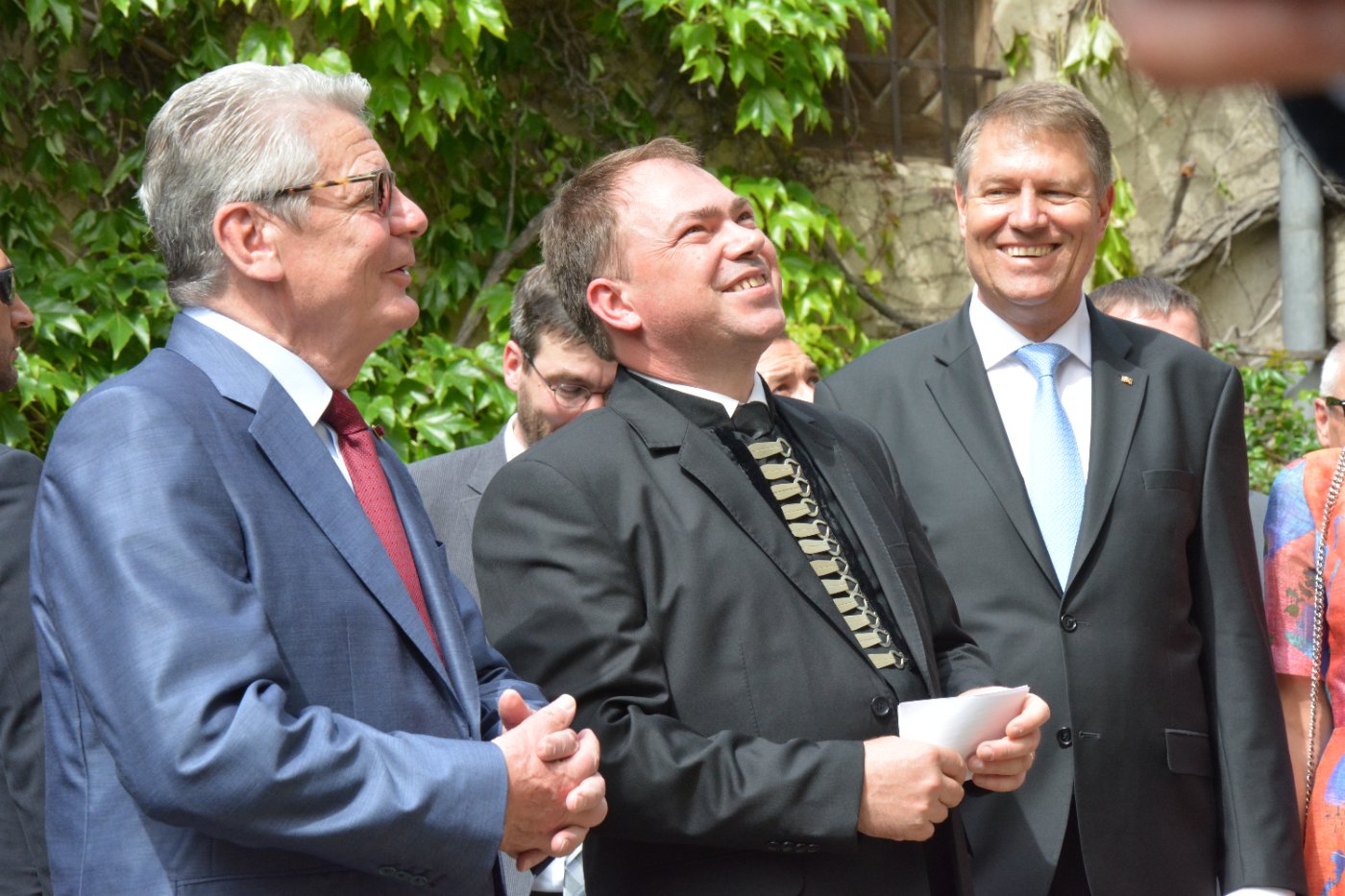
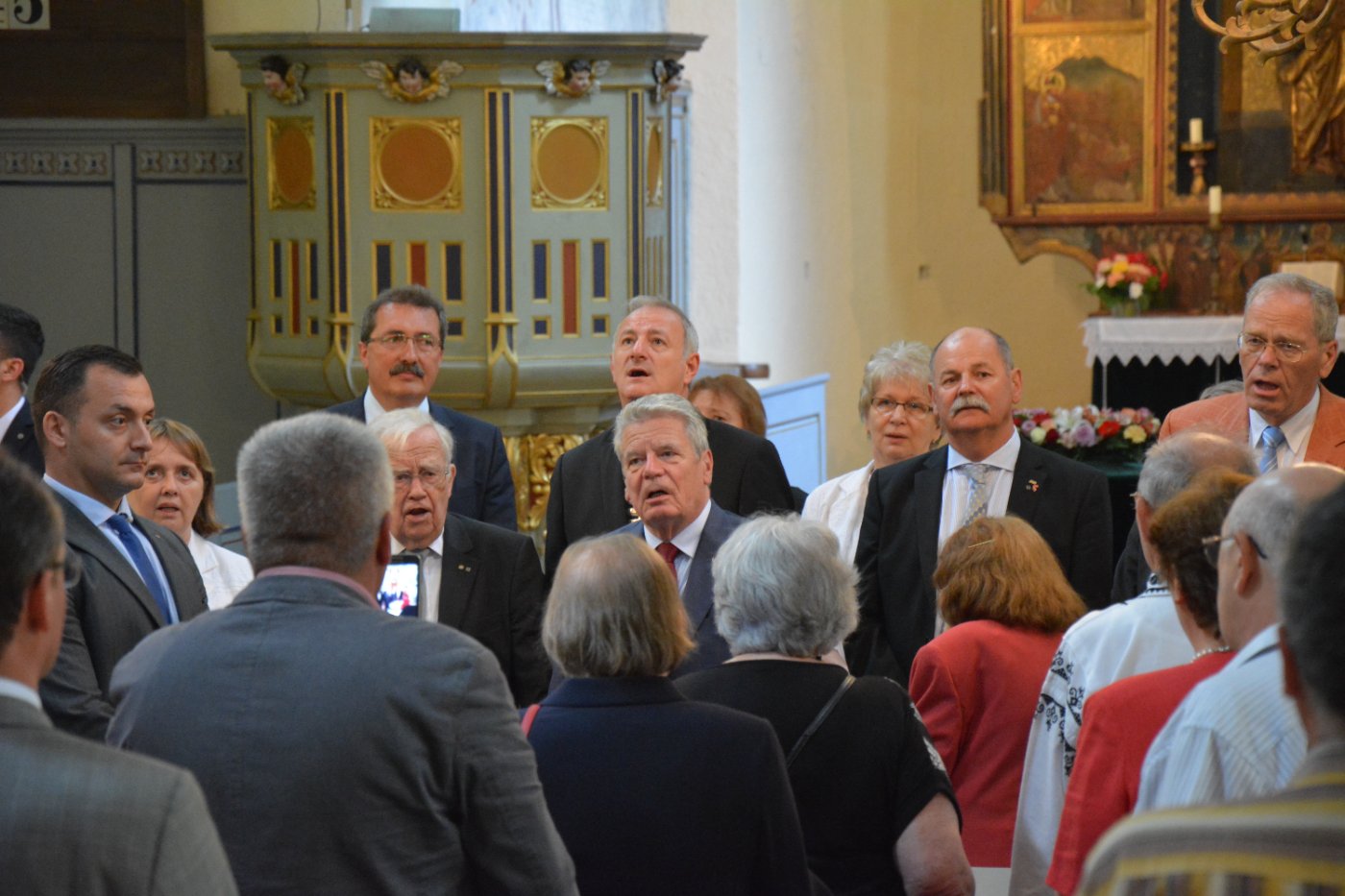
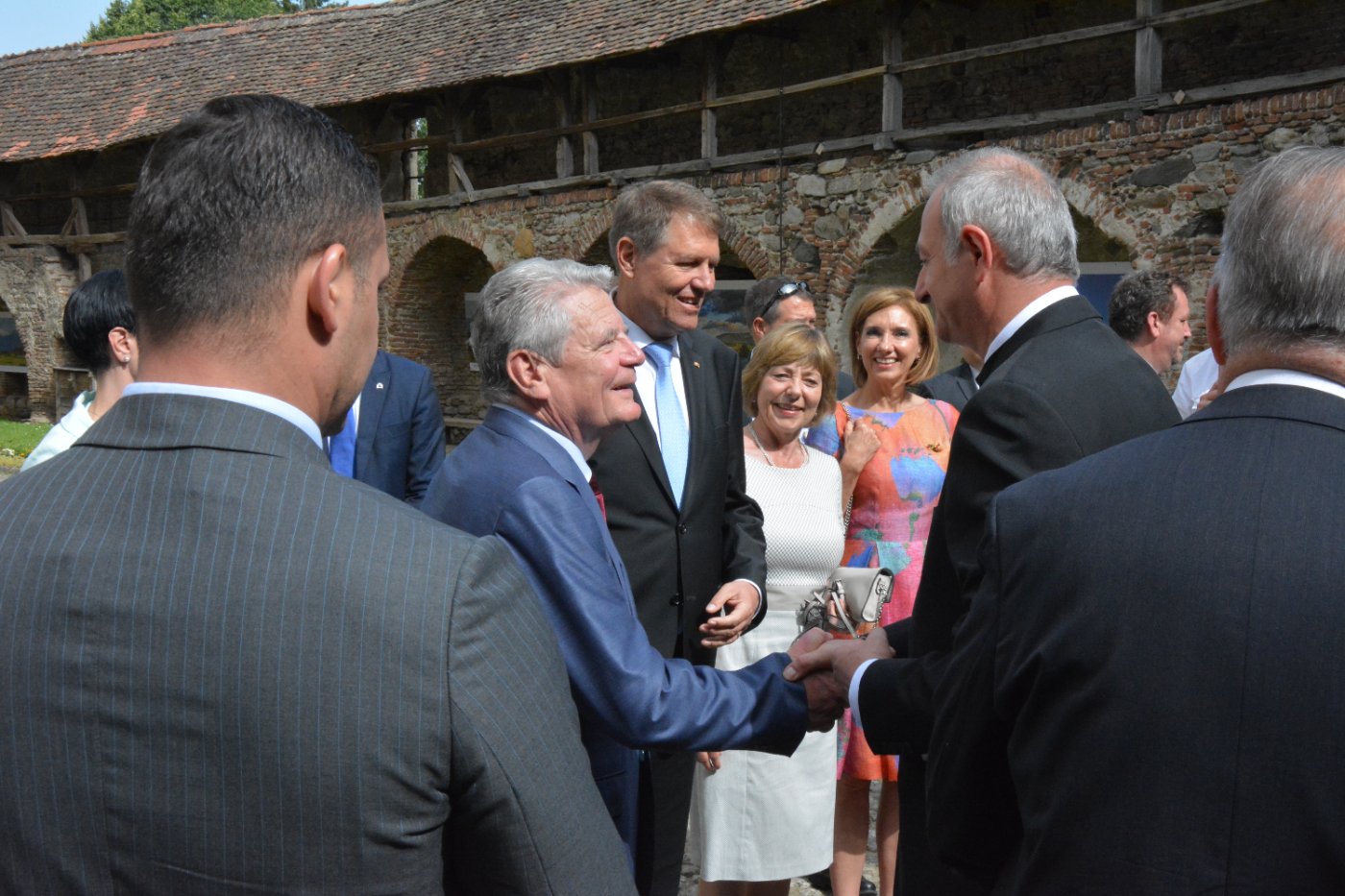
In 2014, representatives of the presidential offices of German President Joachim Gauck and Romanian President Traian Băsescu took on the patronage of the Fortified Churches Foundation in Heltau. In 2016 Gauck visited together with President Klaus Johannis, whose family has been documented in Heltau since the 16th century. On another occasion, state premiers Volker Bouffier and Stanislaw Tillich also came to Heltau.
2019–2023
Church renovation and re-consecration
A comprehensive restoration secures the walls, towers, roof and interior. Half of the required own contribution is carried by the HOG Heltau and the many Heltauer living in Germany – a shared labour of love, made possible above all by the exemplary cooperation with Heinz Hermann and the HOG board. In 2023 the fortified church is solemnly re-consecrated. What generations built and sustained, we pass on well cared for.
Tours
History Within Reach
The secret hiding place, the figural stone, the fresco, on a tour these stories come to life.
› › › Church Renovation
Church · History
The Church Renovation 2019–2023
Between 2019 and 2023 the fortified church was restored, secured and rebuilt step by step, until a solemn re-consecration sealed the completion of the works.
English
Summary
The most extensive building work in over 250 years
{{ leadParagraphEN }}
{{ p }}
Română
Press Release
Cea mai amplă lucrare la biserică din ultimii 250 de ani
{{ leadParagraph }}
{{ p }}
Proiect cofinanțat din Fondul European de Dezvoltare Regională prin Programul Operațional Regional 2014-2020 · Prioritatea de investiție 5.1
The Path to Renovation
2014–2016
Feasibility study
A feasibility study assesses the condition of the fortified church and the scope of necessary works, laying the groundwork for the EU renovation project.
2017–2018
Funding agreement and setbacks
In 2017 the funding agreement for the renovation of the Heltau fortified church is signed. In 2018 two tenders for the construction work initially fail, and preparations drag on.
The own contribution
Carried by the HOG Heltau
Half of the required own contribution is carried by the HOG Heltau and the many Heltauer living in Germany – a shared labour of love. This contribution was only possible thanks to the close and exemplary cooperation with Heinz Hermann and the HOG board.
The Path of Restoration
2019
The beginning
After years of preparation and fundraising, actual construction begins on the badly deteriorated fabric of the fortified church.
2019–2020
Walls, towers and roofs
The ring walls are statically secured, damaged masonry is renewed, and the roofs of the defensive towers are re-covered. Work proceeds in stages so that services and tours can continue.
2020–2021
Pandemic and the nave
Inside, attention turns to the nave, vault and tower, while the pandemic limits congregational life: services take place in the parish garden, the cemetery chapel and the cultural hall, and even Christmas Eve is celebrated in the parish garden. In 2021 the congregation resumes its activities only tentatively.
2021–2022
The final stage
Despite delays, the remaining trades are completed: outdoor facilities, lighting and the final restoration works on the altar and the organ.
2023
The re-consecration
With a festive service followed by a community celebration, the restored fortified church is solemnly re-consecrated in 2023. Guests from partner congregations, authorities and the homeland community celebrate together with the congregation the completion of the restoration works.
During Construction
Notable Discoveries
Graves in the Chancel
Extensive archaeological excavations in and around the church uncover the graves of pastors Georg Brenner and Johann Hutter in the chancel, as well as the foundations of the old baptismal chapel. The final report is expected to shed further light on the church's construction period.
Thanks
Carried by Many Hands
Grants, donations and volunteer work made this restoration possible. Anyone wishing to continue supporting the fortified church is warmly welcome.
› › Treasures
Church
Treasures
Behind thick walls, our congregation preserves treasures from eight centuries: frescoes, manuscripts, sacred vessels and unique works of art. Witnesses of a lived faith, preserved to this day.
The Main Altar from Bruiu
This pre-Reformation winged altar was created around 1520 in the workshop of Johannes Stoß, school of Veit Stoß the Younger, for the church in Bruiu. When that fortified church fell empty and damp and theft threatened the altar, it was taken down in 1999 after a farewell service and consecrated as Heltau's new main altar by Bishop D. Dr. Christoph Klein. In the golden shrine stands the "Bruiu Madonna," attributed to the family or school of Veit Stoß.
The altar regained its original appearance in 1971, when the Bruiu presbytery handed it to the restoration workshop in Brașov, where Gisela Richter painstakingly removed a crude 1728 overpainting. On the feast-day side, four panels depict legends of Saint Nicholas of Myra, to whom the altar was originally dedicated. The weekday side pairs 16 saints in eight dialogues, among them Fabian and Sebastian, Francis and Anthony, Stephen and Lawrence, the Hungarian kings Stephen I and Ladislaus, and John the Baptist with Paul of Thebes. The predella shows the Fourteen Holy Helpers, a foundation of Christian comfort and aid.
The Neo-Gothic Heltau Altar
Built by the Sibiu joiner Bartmus, the Neo-Gothic altar was installed in 1879, replacing the Walburga Church's old pre-Reformation Severus altar. It was consecrated on 23 November 1879 by Bishop Dr. Georg Daniel Teutsch. For 120 years it served as the main altar in the chancel, until it gave way to the Bruiu altar in 1999 and moved to the south gallery, where it stands today.
Rather than movable wings, a fixed, three-part architectural housing with a filigree Neo-Gothic canopy defines its form: pointed tracery balustrades, pinnacles and crosses echo the vertical language of High Gothic sacred architecture. The central pointed-arch field holds an oil painting by the Budapest painter Emil Wünsche, "Jesus Blessing the Children," flanked by statues of the apostles Peter and Paul in painted plaster.
The altar it replaced, the Severus altar of around 1500, went to the Brukenthal Museum on deposit in 1881; only its 1525 predella survives there today. It shows scenes from the life of Saint Severus, patron of wool weavers, with a painter's inscription by Vincentius.
The Wassid Altar
The Wassid altar came to Heltau from the small Saxon community of Wassid (Romanian: Veseud), like so many altars from villages whose parishes could no longer maintain their church furnishings after the Saxons' emigration. Restorers from the Brukenthal Museum discovered an older, high-quality 16th-century paint layer beneath the visible 18th-century Baroque overpainting.
As a late-Gothic painted altar, the shrine forgoes carved figures. At its centre is a Crucifixion with Mary and John, the side wings show the four evangelists at their writing desks, the predella depicts the Last Supper, and the crest above shows Christ's Resurrection. The closed weekday side unfolds the Lutheran programme of Law and Grace in the tradition of Lucas Cranach the Elder: the Trinity above, the Fall of Man and justification through the Lamb of God below.
The Werd Altar
The Werd altar too has found a new home in Heltau: it comes from the small Saxon community of Werd (Romanian: Vărd). Painted digits "1-7-4-6" on the predella's plinths date it precisely to 1746, a fully-formed Protestant Baroque altar with two massive, blue-and-white marbled Corinthian columns.
The central painting shows the Crucifixion, above it in the crest God the Father as blessing Creator, and, as the altar's carved crowning point, the dove of the Holy Spirit within a gilded radiant glory. Two oval medallions illustrate Lutheran teaching on justification: Moses with the tablets of the Law on the left, Christ as Salvator Mundi on the right. The predella carries the words of 1 John 1:7: "The blood of Jesus Christ, the Son of God, cleanses us from all sin. Anno 1746." An inscription records a later renovation by the Evangelical women's association in 1895.
Would you like to view the altars up close and hear their stories? On a guided tour, take your time to discover every detail.
13th century
The Frescoes
A decorative programme that once covered almost the entire interior of the Romanesque basilica: an apostle gallery in the apse, prophets and the four apocalyptic riders in the choir, scenes from the life of Christ, a monumental Last Judgement in the nave, and, most significant of all, the Heltau Throne of Mercy (Gnadenstuhl) on the south clerestory wall.
The Iconographic Programme
The main apse wall carried an apostle gallery, while the half-dome above likely showed a Maiestas Domini. In the reveal of the eastern chancel window appear Saint Walburga, patron of the church, and the parish priest Peter in mass vestments, each named by inscription: "Walburgis Virgo" and "Petrus Plebanus". Six prophets are painted on the chancel arch, and the four apocalyptic riders of Revelation on the vault of the choir bay. The choir walls once carried, in three registers, scenes from the life of Christ: on the north wall the Adoration of the Magi, the Presentation in the Temple, the Crucifixion, the Deposition, the Entombment and the Resurrection; on the south wall the Entry into Jerusalem and the Last Supper.
In the nave, a monumental Last Judgement occupied the north wall, with Christ the Judge enthroned in a mandorla, surrounded by apostles and angels, and, below, the dead rising from their graves. On the south clerestory wall is the Gnadenstuhl, accompanied by the allegorical figures of Ecclesia and Synagoga, alongside a scene with a mounted saint. Smaller fields on the piers show further scenes from Christ's childhood and Passion, all framed by ornamental bands of foliage.
Hidden, Rediscovered, Restored
For centuries the paintings lay hidden beneath whitewash. Their uncovering stretched across more than a hundred years:
1905–1909: partial uncovering on the north and south walls of the choir bay by Fritz Balthes, later whitewashed over again.
1984–1988: uncovering in the reveal of the eastern chancel window, building research by Vasile Sotelecan.
1995–1999: renewed uncovering on the north wall of the choir bay.
2006: conservation and restoration by Kiss Lóránd.
2019–2022: a full restorative survey of the church interior, uncovering all painted surfaces and restoring the Gnadenstuhl composition, again by Kiss Lóránd.
The ensemble ranks among the earliest evidence of Transylvanian wall painting, and covers the largest surface among the first-period paintings surviving in the Romanesque churches of the Saxon settlement area. The paintings were long dated to the 14th century; restorer Kiss Lóránd now argues for the 13th century, pointing to the kinship of the Gnadenstuhl composition with a miniature in the St Elizabeth Psalter (1201–1208). The Gothic majuscule inscriptions suggest a date after the mid-13th century; precise dating awaits further research.
The Heltau Gnadenstuhl
The most striking image shows the Trinity as a "Throne of Mercy": God the Father sits enthroned, holding before his chest the cross with the crucified Christ, while the dove, symbol of the Holy Spirit, hovers above his head. A triple-stepped mandorla encloses the scene like a halo; at lower right a figure with a staff and three mythical creatures breaks through the frame, and at upper left an angel's hand reaches through it. The upper part of the fresco, including part of God's head, was lost when the nave was later heightened and a new arch cut straight through it, a clue that helps date the painting.
The composition is among the earliest of its type in the Holy Roman Empire, likely inspired by the Soest altarpiece of around 1250 (now in Berlin). Related examples appear in the Perpignan Gospels (12th c.), Masaccio's fresco in Santa Maria Novella, Florence (1427), and Dürer's All Saints altarpiece for Nuremberg (1511). A distinctive feature of the Heltau version: the dove hovers not over the head of God or Christ, as usual, but over the heart of Jesus, a singular touch reading the Holy Spirit as the spirit of love and forgiveness.
For a congregation that had survived the Mongol invasion, the image offered both comfort and instruction, a "Bible of the Poor" for the unlettered, painted in the technique typical of fresco: contours sketched in charcoal, then filled in with yellow ochre, black charcoal and red earth, which bonded into the fresh lime plaster.
The Heltau Gnadenstuhl
The Entombment and Lamentation of Christ
The Last Judgement
The Four Apocalyptic Riders
Romanesque chancel window with St. Walburga and Petrus Plebanus
The Wegenstein Organ
The large main organ on the west gallery was built in 1944 by the Wegenstein brothers, replacing the splendid previous organ, which burned down on the night of 24 December 1942. The instrument was last comprehensively repaired in 2014/15 by organ builder Bors László of Tușnad and remains in playable condition.
Builder
Wegenstein brothers
Year built
1944
Manuals
3 + pedal
Action
Electro-pneumatic
The Baroque Organ by Johannes Hahn Junior
This splendid small organ is a work by Johannes Hahn Junior (1763–1814), the most important Baroque organ builder in Transylvania. Johannes Hahn Junior took over his father's Hermannstadt workshop after his death in 1783. The richly decorated case, in white and green with gilded ornaments, is an outstanding testament to Transylvanian organ craftsmanship from the late 18th century.
Builder
Johannes Hahn Junior
Style
Baroque / Rococo
12th century
Heltau Figural Stone
In the southern porch stands a coffin-shaped gravestone with a carved St. Andrew's cross and a stylised face mask. Its archaic style resembles finds from the medieval Rhineland, one of the oldest surviving gravestones in Transylvania.
The stone was found in the interwar period while laying the foundations of the Gromen silk mill, on the grounds of the cemetery closed in 1862, at a depth of about one metre. It is 1.72 m long and 0.63 m wide at the head end. Carved in low relief on the upper face is a cross with short crossbars and broad, edge-curved long arms; in the upper curve sits a simple face mask.
The stone is related to a grave slab in Faha (district of Merzig-Wadern, between the Moselle and the Saar) and another in Irschen (Carinthia), pointing to the original homeland of the later Heltau Saxons in that region, 12th–13th century.
Explained by experts as part of the museum tours.
11th century
The Romanesque Processional Cross "Immigrant's Cross"
Restorers dated this processional cross to the mid-11th century, making it the oldest surviving art object of the Transylvanian Saxons. A wooden core with hammered copper plates, a greenish patina, trefoil arms set with blue semi-precious stones, and a depiction of Christ showing Venetian and Byzantine influences.
The cross was stolen in 2016 and recovered undamaged in 2021 through international cooperation. For security reasons it is now kept at the Regional Church Museum in the Teutsch House, Sibiu.
In 1911, an investigation of the fortified church's oldest chapel uncovered a crypt with human remains. Among them lay this badly damaged cross, nearly discarded, had art historian Dr Viktor Roth not rescued it. Thin sheet copper was hammered over a wooden core: on the front the Crucified with a halo, on the back the Lamb of God with a victory banner, originally set with 32 coloured glass beads.
For decades it lay openly on the church altar, guarded only by an alarm system. In 1990 it was brought to Germany for restoration with the help of Bishop Joachim Heubach and German ambassador Dr Klaus Terfloth; restorers dated it to the mid-11th century, making it the oldest art-historical object of the Transylvanian Saxon church.
Location: Regional Church Museum · Teutsch House · Sibiu
14th century
Medieval Manuscripts
The Heltau Missal, a richly illuminated mass book, one of the most valuable liturgical manuscripts in Transylvania.
The Heltau Missal (Codex Heltensis) is a well-preserved parchment volume in Gothic minuscule, written in two columns of 28 lines per page, with initials in blue and red. The place, date of origin and the scribe's name are unknown.
The model it followed was in use from the 9th to the 11th century in the Cologne-Aachen-Liège region, ultimately going back to Alcuin, teacher and adviser of Charlemagne. It was likely completed into a full missal only in Transylvania, after the settlers moved on from the Magdeburg region around the middle of the 12th century.
1792
The Church Treasure
In the apse of the south aisle lay the so-called treasure chamber, a half-round room behind a solid cross-wall, reachable only through a disguised door: first the pews had to be cleared away, then a hidden spring pressed. The secret of the coin hoard buried within was passed down through generations of church wardens.
When money was lacking for the tower roof repair in 1792, church warden Peter Gündisch revealed the secret: on 5 May 1792, pastor, wardens and elders dug up a pot with 631 ducats and 5 gold sovereigns. A second pot followed on 4 June, together totalling 5,591 guilders and 40 denars, enough to fund the tower repair and a new organ. The chamber was opened twice more, in 1811 and 1821, before the remaining coins were finally sold off in 1847.
Besides the coin hoard, the chamber held precious liturgical vessels for centuries, monstrances, chalices and patens from before the Reformation, as well as a silver cross. Folk belief offered further protection: whoever touched the treasure could not die before confessing the deed.
Since 1916, the church treasure has been on permanent loan to the Brukenthal Museum in Sibiu (Hermannstadt).
1797
The Lightning Rod
The church tower was struck by lightning repeatedly, most recently on 20 May 1795 with considerable damage. Funds from the church treasure were then set aside for the rebuilding, among other things for the purchase of a lightning rod.
In 1797 Heltau received the first lightning rod east of Vienna within Europe, a remarkably early adoption of this still-young technology in the region. Since then, the tower has been spared further lightning strikes.
See the Treasures for Yourself
Many of these treasures can be admired up close on a guided tour. We're happy to tell you the story behind them.
› Community › Services
Community
Services
Sunday after Sunday we gather in St. Walburga Evangelical Church to sing, pray and hear the Word of God. Whether you're a regular or visiting for the first time, you're warmly invited to simply join us.
At a Glance
When
Every Sunday, 10:00 am
Where
St. Walburga Evangelical Church · in winter in the heated parish hall
Language
German, with a Romanian summary
Afterwards
Church café in summer, guests of all denominations welcome
What to Expect
Our service follows the familiar Evangelical liturgy: hymns from the hymnal, prayer, scripture reading and sermon, accompanied by the music of choir and organ. Once a month we celebrate Holy Communion.
In every service, the welcome, scripture reading and a short summary of the sermon are also given in Romanian. On the second day of high holy days, we celebrate a service entirely in Romanian.
Good to Know
The church is accessible at ground level; guests with walking aids or wheelchairs find space at the front.
Children are welcome, a little restlessness is part of a lively congregation.
Anyone wishing a special service (baptism, wedding, anniversary) should contact the parish office.
Through the Church Year
Advent & ChristmasFestive services with choir, Christmas Eve vespers.
Lent & EasterGood Friday with Communion, festive Easter service.
ConfirmationIn spring we celebrate confirmation with our young congregation members.
Harvest FestivalThanks for the year's gifts, the church festively decorated.
RemembranceOn the Sunday of the Dead we remember those of our congregation who have passed away.
Celebrate With Us
Our doors are open on Sundays at 10 am. A first visit commits you to nothing, simply come by.
› Community › Groups
Community
Groups
Congregation is more than Sunday morning. During the week, people of all ages meet to sing, learn, play and spend time together. There's sure to be a group for you too.
Music
For Children
Children's Choir
Singing, playing, learning new things together and performing before the congregation on feast days. A cheerful gathering for children of primary school age.
The choir contributes musically to services and festivals. Reading music is a plus, but not required, enjoying singing is enough.
Weekly rehearsal
Youth Band
Luminia
Our youth band brings contemporary sound into the congregation, with guitars, drums and voices. Young people who love making music are always welcome.
Thursdays, 6 pm · Cultural Hall
Education & Faith
For Adults
Bible Study & Education
Discussing biblical texts, questions of faith and life today. Open to anyone who wants to go deeper or simply join the conversation.
Once a month · in German and Romanian · Parish House Contact: Pastor László-Zorán Kézdi
For Adults
Evangelical Dialogues
A discussion circle for adults, open to questions of faith and of living together, in open exchange with one another.
Irregularly Contact: Pastor László-Zorán Kézdi
Not a Group · School Lessons
Religious Education
Not a group activity but school teaching: on behalf of the church, Evangelical religious education is given at the Gustav Gündisch High School, reaching many children and young people in their school day.
Gustav Gündisch High School
For the Young
For Youth
Youth Group
Talking about God and the world, group outings, preparation for confirmation, and simply a good time among peers.
In summer, our young people volunteer to guide visitors from around the world through the fortified church, the core of our youth group.
Volunteer in summer
Fellowship
For Seniors
Seniors' Circle
We meet monthly, alternating between an afternoon seniors’ gathering over coffee and cake and a shared lunch at the Elim Home. Anyone needing accompaniment is gladly picked up.
Monthly · Parish Hall / Elim Home Contacts: Brigitte Fleps and Rosina Ruopp
For Everyone
Church Café
On summer Sundays we invite you after the service to coffee and conversation in the fortress courtyard. Locals and travellers strike up conversation.
Sundays in summer, after the service
Feel free to join a meeting without obligation, or give us a call, we'll gladly tell you when each group meets next.
› Community › Church Music
Community
Church Music
For centuries, music has resounded in our church, carried by the sound of the organ and the voices of the choir. It is prayer, festive garment and invitation all at once.
Concert Series
Echoes of the Fortress
Every summer, the fortified church invites you to a special musical experience: music in the medieval vault, carried by the unique acoustics of the space. Renowned organists, the church choir and guest ensembles create evenings that unite music and history.
Our Groups
Music for All Generations
The Church Choir
Our choir shapes services on feast days musically and performs at regional concerts and choir gatherings. Rehearsals are held once a week, in an open and warm circle.
Enjoy singing? Come to a rehearsal, no strings attached.
Rehearsal: Thursdays, 7 pm · Cultural Hall · Director: Cosmina Barna
Children's Choir
Children discover music from an early age, singing at services and congregational celebrations and experiencing how their voice becomes part of something bigger.
All children of the congregation are warmly welcome.
Rehearsal: Saturdays, 11 am · Cultural Hall · Director: Cosmina Barna and Mihaela Fülöp
Youth Band
Luminia
Youth band Luminia brings contemporary sounds to the congregation, with guitars, drums and vocals. It shapes youth services and special congregational evenings.
Music-loving young people are welcome anytime.
Rehearsal: Thursdays, 6 pm · Cultural Hall · Director: Cosmina Barna and Mihaela Fülöp
Join In
Let Your Voice Be Heard
Whether in the choir or as a guest at a concert: music unites. We look forward to seeing you.
› Community › Baptism, Weddings & Pastoral Care
Community
Baptism, Weddings & Pastoral Care
At life's great turning points, in joy as in grief, we are by your side. Here you'll find how to arrange a rite of the church and who will accompany you.
Baptism
Would you like to have your child baptised, or be baptised yourself? We rejoice with you. Contact the parish office, in a personal conversation we'll arrange the date, godparents and the course of the baptism service.
In confirmation classes, young people engage with questions of faith and life and, at the end, affirm their own baptism for themselves. Classes begin every autumn.
Registration & start: Parish Office
Weddings
Our historic church is a festive place to begin your shared path under God's blessing. Contact us early, and together we'll shape your wedding service.
In parting, we don't leave you alone. We arrange the funeral service and accompany families with pastoral care, with time, calm and dignity.
In case of bereavement: Parish Office · +40 269 564 597
Pastoral Care & Home Visits
Sometimes a confidential conversation does good. In worry, illness or simply a wish for comfort, we're happy to visit you at home or in hospital, confidentially and without preconditions.
Arrange a conversation: Parish Office · +40 269 564 597
We're Here for You
Baptism, wedding, or a conversation in a difficult time, a phone call is enough, and we'll make time for you.
› Community › Diaconal Care
Community
Diaconal Care
Faith shows itself in action. Our congregation's diaconal work accompanies people in difficult life situations, concretely, personally and without preconditions.
Our Understanding
"For I was hungry and you gave me something to eat, I was thirsty and you gave me something to drink, I was a stranger and you invited me in."
Matthew 25:35
Diaconal care is not a programme, but an attitude. It belongs to the very core of Evangelical congregational life, as lived love of neighbour that is not confined to Sunday worship.
In Heltau, staff and volunteers work to accompany people in particular life situations: the sick, the lonely, families in need, older people without support.
Focus Areas
What We Do
Visits to the Sick and Elderly
Congregational deacon Rosina Ruopp regularly visits sick and elderly congregation members at home or in care homes, for conversation, personal companionship, and to arrange practical support.
Occasionally, and on request, Pastor Kézdi visits in person too. He gladly offers Communion at home, a special form of pastoral care for those who can no longer come to church.
Contact: Rosina Ruopp · reachable through the parish office
Pastoral Care
In life crises, bereavement or times of being overwhelmed, the pastor and trained volunteers are available for conversation.
This support is confidential, free of charge and without preconditions, for congregation members and outsiders alike. Contact the parish office directly.
Contact: via the parish office · confidential
Institutions & Associations
Organised Help on the Ground
Congregational Association
Initiativa Christiana
Our own congregational association, "Initiativa Christiana", was founded in 1999 on the initiative of the Evangelical-Saxon congregation. Its goal is to raise funds through the resale of second-hand goods to support people in need, including help covering the cost of gas, electricity and medication. The association also funds projects of the parish and of schools in Heltau.
The second-hand shop is located at Langgasse (str. Lunga) no. 28. The association's chairwoman is Eveline Cioflec.
After-school Centre · since 2001
Noah's Ark
The "Noah's Ark" after-school centre was founded in 2001 for children in need in Heltau. Around 35 boys and girls receive a warm meal daily, help with homework and space to play. The centre is run by the Diaconal Service of the Evangelical Church A.B. in Romania.
Young adults who went through the Ark as children and are now in training or working continue to be supported.
The centre is supported by Christ Church Parish Kassel, numerous private donors, and the City of Heltau.
Volunteering
Join In: An Afternoon Can Mean a Lot
Diaconal work thrives on voluntary commitment. Anyone wishing to visit an elderly person, support a family, or simply bring time is warmly welcome. No prior experience needed, just a willingness to listen.
No special prior knowledge needed
Time commitment based on your own availability
Guidance and introduction from the congregational deacon
Contact
Need Help, or Want to Help?
Contact the parish office. We'll pass your request on confidentially and quickly to the right place.
› Community › Parish Office
Community
Parish Office
The parish office is the first point of contact for all matters concerning our congregation, from registering a baptism to booking a church tour. Here's how to reach us.
Your Contacts
Pastor László-Zorán Kézdi
As the congregation's pastor, I accompany people through the bright and difficult hours of their lives, at baptisms and weddings as well as in pastoral conversation. Our doors are open to you, whether you belong to the congregation or are here for the first time.
For God's invitation knows no threshold, it is extended to the stranger as much as the familiar, to the doubting as much as the assured. To me, being welcoming means recognising the image of God in every person and meeting them with the same openness with which Christ himself met tax collectors and sinners. So I understand our congregation as a place where no one need remain a guest, but where everyone can find a home.
Our Team
Five Staff Members and Many Volunteers
The parish office serves as the coordinating centre for all congregational activities, both spiritual and administrative. The staff team is complemented by congregational deacon Rosina Ruopp and numerous volunteers. Together they ensure the smooth running of services, events, administrative tasks and pastoral care.
László-Zorán Kézdi
Pastor
Claudia Bogdan
Parish Secretary
Cosmina Barna
Church Musician
Robert Bell
Sexton
Werner Schuller
Cemetery Administrator
Rosina Ruopp
Congregational Deacon
Adelina Csaszar
Religious Education
How to Reach Us
Opening hours
{{ hoursPfarramt }}
Address
{{ addrOrg }}, {{ addrStreet }} {{ addrPostalCity }}, Sibiu County, Romania
A congregation lives through people who take responsibility. The presbytery leads our congregation together with the pastor, voluntarily, with heart and perseverance.
Who Carries Responsibility
Pastor
László-Zorán Kézdi
Robert Fink
Church Warden
Bella Fülöp
Church Father
IG
Irene Gaspar
Church Mother
HS
Heinke Schüller
Presbyter
Laura Brainas
Presbyter
Liviu Trifan
Presbyter
What the Presbytery Does
The presbytery, the elected congregational council, together with the pastor bears responsibility for the spiritual, structural and financial life of our congregation. It manages the fortified church, plans events, oversees diaconal work and decides on major questions. It is elected by congregation members; it meets regularly and welcomes anyone who wants to think and work alongside it.
The Congregational Assembly
The congregational assembly is the lay body elected by congregation members. It consults and decides on fundamental questions of congregational life, including budget, congregational bylaws and long-term development. Together with the presbytery, it bears responsibility for the direction and future of the congregation and ensures that important decisions have broad support.
Former Pastors
August Schuster · 1924–1942
Johann Kondert · 1943–1944
Gustav Kaestner · 1944–1958
Wilhelm Peter Thal · 1960–1972
Dr. Paul Gerhard Schullerus · 1972–1996
Dr. Stefan Cosoroabă · 1996–2008
László-Zorán Kézdi · since 2009
Former Church Wardens
Tom Binder · 2001–2005
Dieter König · 2005–2007
Johann Krech · 2007–2017
Christian Draghici · 2017–2020
Johann Krech · 2020–2021
Ortwin Herbert · 2021–2024
Robert Fink · since 2024
Would You Like to Get Involved?
Whether with time, an idea, or helping hands, every contribution strengthens our congregation. Simply get in touch.
› Community › Cemetery
Community
Cemetery
The Evangelical cemetery in Heltau is a place of stillness, remembrance and dignity, tended with care for the departed and their families.
A Place of Rest
Resting in Dignity in Heltau
The Evangelical cemetery in Heltau has for centuries been the congregation's final resting place. It is carefully tended by Werner Schuller, so that this place preserves its dignity and peace.
[Location, history and notable graves to be added.]
Practical Information
Open
Daily, 10 am – 6 pm
Location
Str. Cetății Nr. 22, Heltau
Contact
Werner Schuller · Cemetery Administrator
Contact
Funerals
Reporting a Funeral
In case of bereavement, we accompany you with dignity through every step. Please contact the parish office promptly, we'll make time for you.
Grave Care
Care & Usage Rights
For questions about grave usage rights, grave care, or plot occupancy, please contact the cemetery administrator or the parish office.
Impressions
We're Here for You
In case of bereavement or questions about the cemetery, a phone call is enough, and we'll make time for you.
› Community › Partner Parishes
Community
Partners
Our congregation does not live for itself. Across borders and denominations, friendships and partnerships unite us, sharing faith and cultivating fellowship.
Home Community Association
HOG Heltau
The home community association HOG Heltau brings together former Saxon residents of Heltau living in Germany and their descendants. It keeps alive the memory of the old homeland, supports the preservation of the fortified church, and has accompanied the congregation in Heltau for decades through advice, donations and personal involvement.
Whether restoration projects, the annual church consecration festival, or the bond between generations, the HOG is an important bridge between the emigrated congregation and those who remain.
In 2024 we signed a partnership agreement with the Auferstehungs-Samariter parish in Berlin-Friedrichshain. This partnership unites two very different congregational lives, the small Transylvanian Saxon parish and the big-city congregation in the heart of Berlin, in the same Evangelical faith.
Regular visits, mutual intercession and the exchange of experience about congregational life mark this young partnership, built to last.
Partnership agreed
Evangelical Parish Osijek, Croatia
A further partnership has been agreed with the Evangelical parish of Osijek, Croatia. It extends our network of relationships to an Evangelical parish in south-eastern Europe, with which we share a similar history as a minority church.
Concrete steps, mutual visits, joint projects and spiritual exchange, will grow in the years ahead.
Would You Like to Deepen the Connection?
Whether a visit, exchange, or your own partnership idea, we welcome your interest in our relationships.
› Community › Fortress Guides
Community · Church
Fortress Guides
Every summer, young people aged 14 to 19 open the gates of the fortified church and guide visitors from around the world through eight centuries of history, voluntarily and with visible joy.
Youth Volunteering
Young Hosts for Old Walls
In the summer months, children and young people of the congregation take over the tours through the fortified church. They explain the secret hiding place, tell of Ottoman sieges and plague years, and point out the frescoes and altars, often in several languages and for guests from all over the world.
This group of fortress guides is also the core of our youth group. Whoever joins in dives deep into the history of the church and Transylvanian Saxon traditions, and becomes part of a community that holds together well beyond summer.
The tradition dates back to 2007: in the European Capital of Culture year in Hermannstadt, young fortress guides were involved for the first time, to bring visitors closer to the history of the fortified church.
What Fortress Guides Take With Them
More Than a Tour
History on Site
They learn the chronicle of the fortified church, from the first documentary mention to the restoration, and pass it on in their own words.
Language & Presentation
Guiding tours in German, Romanian and English builds confident public speaking and connecting with visitors from around the world.
Community
Fortress guides form the core of the youth group. Those who take part often stay connected beyond summer, with friendships and responsibility for their own congregation.
For children & young people 14–19
Join Us
Before summer, new fortress guides are trained and introduced to the history of the fortified church. Interested? We welcome anyone who wants to take part.
Training in spring · active over summer Contact: via the parish office
Plan a Visit
Let Yourself Be Guided
In summer our young guides await you, year-round, the parish office. Book your tour.
› Events
From Congregational Life
Events & News
What's coming up in the life of our congregation.
Upcoming Dates
Loading…
Loading error
{{ t.day }}
{{ t.monthStr }}
{{ t.weekday }}
{{ t.catLabel }}
{{ t.title }}
{{ t.detail }}
›
No dates in this category.
Stay Up to Date
Follow Us on Facebook and Instagram
Between the updates here, we share day-to-day news, photos and short-notice announcements there.
Closing service of the Festival Days in Transylvania
On 16 August, the festive closing service of the Festival Days in Transylvania took place at the Heltau fortified church. Bishop Reinhart Guib led the service and placed gratitude for a living community at the centre of his sermon.
Guests of honour included Consul Wiebke Oeser (Federal Republic of Germany), Dean Galter, district church curator Dr. Carmen Schuster, Thomas Schneider (chairman of the Association of Transylvanian Saxon Home Communities) and Michael Konnerth (HOG regional group Hermannstadt and Harbachtal).
During the celebration, the curators of the Hermannstadt church district received public recognition for their voluntary service. After the liturgy, the Heltau project group and the dance group of the Hermannstadt Youth Forum presented the cultural programme in the churchyard.
Castle Night in Heltau
Following the festive service, the Walburga fortified church in Heltau opened its gates for the traditional Castle Night. The programme offered visitors a mix of exhibitions, music and shared activities in the historic grounds.
The evening began at 6 pm with the closing of Horst Lutsch’s exhibition “Timpuri suprapuse”, followed at 6:20 pm by the opening of an exhibition by Claudius Ciucă on the tradition of the volunteer fire brigade in Heltau. At 6:45 pm, Cosmina Barna on the organ and Erika Klemm on the clarinet gave a concert of baroque music.
From 7:30 pm the action moved to the inner courtyard for a shared picnic. At the same time, the children’s pub opened with a creative workshop for younger guests. At 8:30 pm the music continued with live performances by Acoustic Band and Luminia. The evening closed at 11:30 pm with a Taizé prayer.
On this Sunday, the three Heltau bells rang together in their old order for the first time again. Christian Fülöp and Ioan Crai modernised the automatic bell-ringing system, and the full sound of all three bells can now be heard again every Sunday.
16
July 2026
Church Music · Concert
Vocal ensemble N.E.o.N. from Berlin visits the fortified church
On 16 July, the vocal ensemble N.E.o.N. from Berlin sang at the Heltau fortified church, and the evening was simply captivating. Under the direction of Anton Berron, the twelve singers spanned five centuries of choral music, from Renaissance polyphony to contemporary sounds, with a precision and warmth that filled the whole church.
The voices blended effortlessly, and the church's acoustics gave every piece its own sound. The evening was part of a larger tour: after INITIUM, which took them all the way to Rome in 2024, and CONTINUUM, which in 2025 went through Berlin, Cottbus, Dresden and Zwickau, TERTIUM is their third tour and this year takes them through Berlin, Sibiu, Heltau and Petersdorf.
We thank N.E.o.N. for this rare musical evening.
12
July 2026
Art · Exhibition
Overlaid Times. Painting and digital metamorphoses – a look back at the opening
On 12 July 2026 we opened the exhibition of Horst Lutsch at the Heltau fortified church. Pastor Kézdi welcomed the artist and those present, before Horst Lutsch himself introduced the exhibition. His work moves between classical painting and so-called „Digital Metamorphoses", photographic transformations created directly on the smartphone.
Historic rooms, sacred architecture and everyday fragments condense into layered visual worlds between memory and the present. His art seeks no academic perfection. It tells of time, change and the traces of a life lived. Horst Lutsch comes from Transylvania and has lived for years in the Herrenberg/Stuttgart area. The connection to his homeland remains tangible in his work.
The exhibition runs until 16 August at the Heltau fortified church.
04
July 2026
Fortress · Festival
Transilvanian Brunch at the Heltau Fortified Church
The Transilvanian Brunch took place on 4 July at the Heltau fortified church. The programme began at 11 am with local gastronomy: regional specialities, seasonal ingredients and authentic recipes, with local producers involved.
From 1 pm to 3 pm the cultural part followed: a tour of the fortified church, mini organ concerts, a textile workshop for children and a quiz on architectural treasures. From 3 pm to 5 pm there was music and relaxation in the parish garden.
The Transilvanian Brunch is a travelling project. It began in 2008 and is now in its 19th year. The event supports small communities, seasonal products from local producers and the preservation of cultural and natural heritage.
Thanks to the local partners Sibiu Turism and Slow Food Transylvanian Heritage. Thanks to all volunteer helpers.
03
July 2026
Fortress · Volunteering
Our young fortress guides are back on duty
Our young fortress guides welcome you again this year to the Heltau fortified church. On the tour you experience the history, culture and tradition of this place. The guides tell you about the people who lived here, the walls that protected them, and the congregation active here today.
The company Euchner Cisnadie, together with Axente Neagu, has once again sponsored the T-shirts for our volunteer fortress guides. We thank them on behalf of the Evangelical parish of Heltau.
30
June 2026
Fellowship
Seniors’ gathering at the Elim Home in Michelsberg
18 seniors, congregation members and friends of the congregation met at the Elim Home in Michelsberg. There was a good lunch and plenty of time for conversation.
At the centre stood a thought about unplanned paths. Through Peter and Paul we reflected on how God often leads people differently than they themselves would have planned. An unplanned path is not a failure. Sometimes it is the only path that leads anywhere.
We thank the Elim Home for the warm hospitality. A lovely afternoon full of fellowship and good conversation.
29
June 2026
Organ
Work on the organ has begun
Work on our Wegenstein organ has begun. Organ builder Albert Balogh has collected the first pipes and taken them to his workshop. There he cleans them carefully, pipe by pipe.
This moment is a beginning. An instrument built by generations before us is getting its voice back. That is only possible because so many of you are joining in with your donations. For this we thank you from the heart, today and for every further support.
When the organ is finished, it shall sound again with its full voice, in concerts and in services. Every donation brings us closer to that sound.
Fortress guide seminar at the Heltau Fortified Church
On 6 June the fortress guide seminar took place at the Heltau fortified church. The young fortress guides refreshed their knowledge of the history and special features of the complex. Alina and Christian Scholtes led the afternoon with a course on what carries a good tour: confident presence in front of groups, dealing with stage fright and an awareness of the significance of this work.
We thank all participants. The season can begin. Let our fortress guides accompany you through 800 years of history.
06
June 2026
Music
Meeting of the Evangelical choirs in Bartholomae / Kronstadt
Members of the Heltau church choir took part in this year’s meeting of the Evangelical choirs, held in Bartholomae / Kronstadt. Together with choirs from across our church, they rehearsed and sang.
Many thanks to the organisers and all participants.
Anyone who enjoys singing is warmly welcome, simply come along to the next choir rehearsal. No prior knowledge, no further obligations.
02
June 2026
Fortress · Encounter
Episcopal delegation of the EKKW partner churches conference visits
On Tuesday afternoon, 2 June, the episcopal delegation of the EKKW partner churches conference was a guest at the Heltau fortified church.
After a tour of the fortified church, the bishops from Namibia, South Africa, India, Kyrgyzstan, Estonia, Germany and Romania met congregation members for conversation. The focus was on education work in school and congregation. An open exchange about what we do, why we do it, and what drives us.
We are grateful for this encounter and for the joy of sharing our work with people walking the same path.
24
May 2026
Art · Exhibition
„Hanami“: Katia Scholtes exhibits in our church
Katia Scholtes is exhibiting in our church, and we are delighted. „Hanami“ can be seen from tomorrow until 26 July in the Evangelical Church Heltau.
The title refers to the wondering contemplation of cherry blossoms, and it lives from a paradox: the blossom is beautiful because it passes. Katia has created something quiet and at the same time alive.
A warm invitation to the vernissage and the exhibition!
24
May 2026
Service · Congregation
Seven new members welcomed at Pentecost
God calls people along winding paths. On Whit Sunday we welcomed seven new members into our congregation, each of them with their own story, their own path, their own questions.
This congregation welcomes them as they are. They now belong. We are glad to have them with us and to accompany them on their way.
We wish them to find a home in our congregation and to experience God’s blessing.
08
March 2026
Walburga Festival · Award
Walburga Prize 2026 awarded
On Sunday, 8 March 2026, the Evangelical parish A.B. Heltau awarded the Walburga Prize 2026 during the festive service for the Walburga Festival. The sermon was given by Bishop Reinhart Guib.
The prize was awarded to Friedrich Gunesch, chief legal counsel of the Evangelical Church A.B. in Romania. With the Walburga Prize the parish honours people who, through their service to church and community, take on responsibility and strengthen Evangelical life in Heltau and Transylvania. The presbytery thanks the laureate for his service to the church, for his unifying work and for his reliable support of the Heltau parish, especially during the renovation years 2019 to 2023.
At the laureate’s request, the prize money of 3,000 lei will be donated to the children’s hospice in Sibiu.
We thank all guests of honour who celebrated this day with us. It was a special joy to welcome the representative of our Berlin partner parish Samariter-Auferstehung as well as our guests from the Evangelical Church in Osijek, Croatia.
We thank the church choir, the children’s choir and the youth band for the musical accompaniment, and we thank all staff and volunteers who prepared and carried this day.
No posts for this year.
› Contact
Contact
How to Reach Us
Whether for a baptism, a tour, or simply a question, we're glad to hear from you. Here you'll find all the ways to reach us.
Address
{{ addrOrg }} {{ addrStreet }} {{ addrPostalCity }}, Sibiu County Romania
The simplest option: about 7 km, roughly 10–15 minutes. Both ride-hailing apps operate reliably in Sibiu, right from the station.
From Sibiu Train Station
By bus (line 581)
Take a city line from the station to "Mihai Viteazu" or "Kaufland Arhitecților", then transfer to the metropolitan line 581 (Tursib) to Cisnădie, stop "Str. Cetății 2". Alternatively via Michelsberg: city line 13 to "Muzeul Astra", then line 582 to Cisnădie.